Standing water in a crawl space usually comes from one of three places: rain running off the roof and soaking the soil beside the foundation, groundwater rising up through the dirt floor, or a leaking pipe under the house. Water that appears during or right after storms points to the first; water that lingers through dry spells or seeps up evenly points to the second; water in one spot, or on dry days, points to plumbing. Start outside with gutters, downspouts and grading, which cost the least, and add a sump pump and drainage only if water still collects. Stay out of the water until the power to anything down there is off.
Do not crawl into standing water where wiring, a pump, a water heater, ductwork with electric parts or extension cords may be wet. Have the power shut off by your utility or a licensed electrician first. Federal flood-safety advice from CDC is blunt: never work a switch or an appliance with your feet in water.
Why water collects under the house
A crawl space usually sits below the surrounding ground and is open to the soil, so water that reaches the foundation tends to end up there. The Department of Energy’s Building America guidance for existing crawl spaces puts bulk water first: deal with drainage, then worry about moisture control.
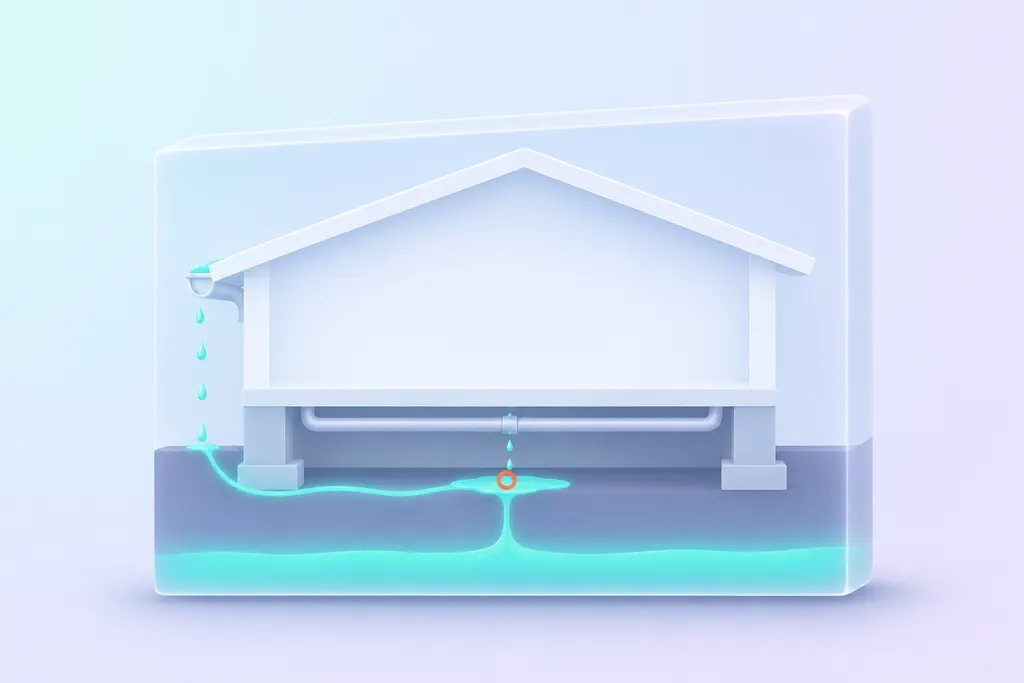
- Roof runoff and grading. Gutters that overflow and downspouts that empty beside the wall dump a whole roof’s worth of rain into the soil right against the foundation. If the ground slopes toward the house, surface water joins it. Patios, walks and driveways that tilt toward the house do the same.
- Groundwater. On low lots, in wet seasons or where the soil drains slowly, the water table can rise into the crawl space and come up through the floor. It tends to linger for days and may return every wet season.
- Plumbing. Supply lines, drain lines, a water heater or an air-conditioning condensate line can leak or drip under the house. This kind of water shows up regardless of the weather.
Outside water, groundwater or a pipe? Check without crawling in
You can learn most of what you need from outside the house and from the access opening with a flashlight.
Three sources of crawl space water
Switch between the options to compare them point by point.
- When it shows up
- During or just after storms; drains away within days.
- Where
- Near downspouts, low corners or walls facing a slope.
- First fix
- Clean gutters, extend downspouts 5–6 ft or more, regrade soil away from the wall.
- When it shows up
- In wet seasons; lingers through dry spells and comes back each year.
- Where
- Seeps up across the low parts of the floor.
- First fix
- Sump pit at the low point, often with a perimeter drain.
- When it shows up
- Any time, including long dry spells.
- Where
- Under a pipe, the water heater, a drain line or a condensate line.
- First fix
- Meter test, then a licensed plumber.
Find the source without crawling in
Work from outside and from the access opening. Ticks stay in this browser only.
0 of 8 done
EPA’s WaterSense program suggests a two-hour meter test: read the water meter, use no water at all, and read it again. Any movement suggests a supply leak. That points you to a licensed plumber rather than a drainage contractor.
Start with the outside
The fixes that cost the least also address the most common cause. Nebraska Extension advises letting downspout water out 5 to 6 feet from the foundation, and the Department of Energy’s guide says at least 5 feet, so plan on extensions of that length or more. The same Extension publication recommends that soil next to the house drop at least 6 inches over the first 10 feet.
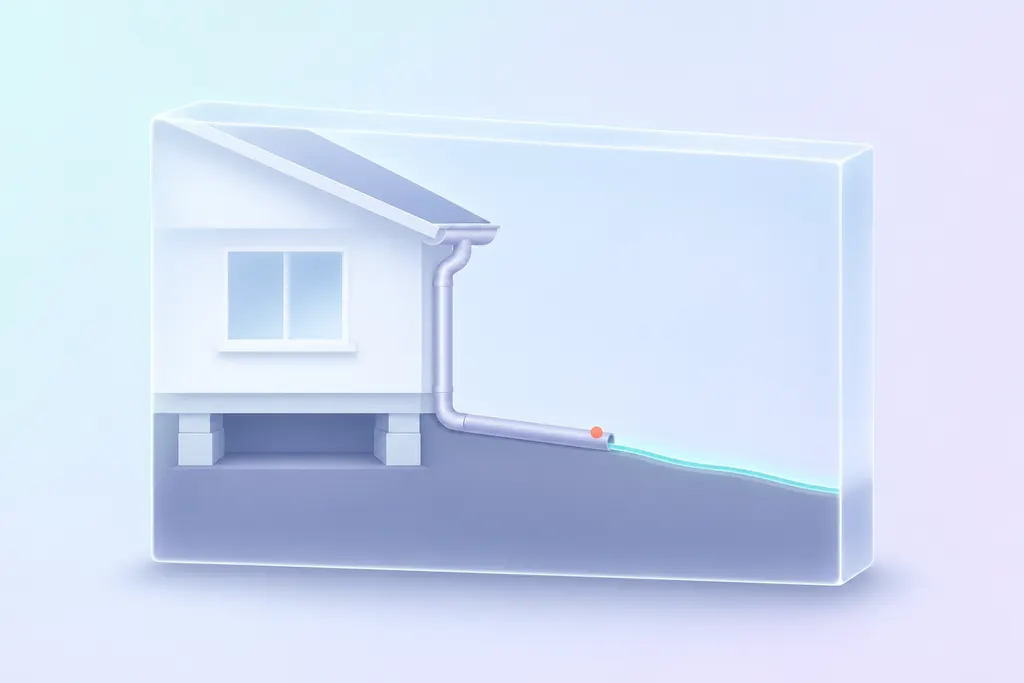
Building America’s guide also suggests checking crawl space vents and window wells that sit at or below the ground, which can let surface water pour straight in, and sealing them with durable, waterproof materials or filling the wells to above grade.
Give these changes a few storms. If the crawl space stays dry, you have spent the least possible.
When water still collects: sump and drainage
If water rises from below even with the roof water handled, it needs a way out. Building America describes the usual setup: a sump pit 2 to 3 feet deep at the low point of the crawl space floor, with holes in the bottom so rising water is pumped away before it reaches the surface, and a gasketed, tight-fitting lid. Contractors may also run a perimeter drain to the pit. The pump should discharge well away from the house, not back into the soil beside the foundation.
Only after the water is under control does a ground cover or full encapsulation make sense. Laying plastic over a wet floor traps the problem; the guides we read put drainage first. For what comes next, see crawl space vapor barrier cost and crawl space encapsulation cost.
What the fixes cost
Sources price these jobs very differently, partly because “drainage” ranges from a short trench to a full perimeter system. Use the ranges as a sense of scale, not as a quote.
Crawl space water fixes: published ranges
Select a column heading to sort. National ranges, not quotes.
| Unit | ||||
|---|---|---|---|---|
| Gutter and downspout cleaning | $200 | $400 | per visit | Fixr — Basement waterproofing cost · updated Feb 2026 · read Nov 2026 |
| New gutters and downspouts | $3 | $30 | per linear foot | Fixr — Basement waterproofing cost · updated Feb 2026 · read Nov 2026 |
| Downspout extension (the part) | $2 | $17 | each | Fixr — Downspout installation cost · updated Jan 2025 · read Nov 2026 |
| Soil regrading around the house | $500 | $3,000 | per project | Fixr — Basement waterproofing cost · updated Feb 2026 · read Nov 2026 |
| Crawl space drainage system One source | $600 | $1,800 | per project | This Old House — Crawl space encapsulation cost · updated Mar 2026 · read Nov 2026 |
| Crawl space sump pump, installed (single figure) One source | $1,300 | $1,300 | per pump | HomeGrail — Crawl space encapsulation cost · updated Jan 2026 · read Nov 2026 |
| Crawl space water removal and repair One source | $2,000 | $10,000 | per project | Fixr — Crawl space repair cost · updated Jan 2025 · read Nov 2026 |
| Crawl space dehumidifier | $750 | $1,700 | per unit | Fixr — Crawl space repair cost · updated Jan 2025 · read Nov 2026 |
| Crawl space dehumidifier with wiring | $800 | $2,000 | per unit | This Old House — Crawl space encapsulation cost · updated Mar 2026 · read Nov 2026 |
| Crawl space mold removal | $500 | $2,000 | per project | Fixr — Crawl space repair cost · updated Jan 2025 · read Nov 2026 |
| Crawl space mold removal | $500 | $4,000 | per project | This Old House — Crawl space encapsulation cost · updated Mar 2026 · read Nov 2026 |
What moves the number:
- Access. Low clearance, debris and old insulation make every job slower.
- How far water has to travel. A sump needs a discharge line to a safe spot in the yard; long or buried runs cost more.
- Damage already done. Fixr lists water removal and repair at $2,000 to $10,000, and the two crawl space guides we read put mold removal at $500 to $2,000 (Fixr) or $500 to $4,000 (This Old House). Wet insulation usually has to come out.
- Power. A sump or dehumidifier needs a circuit near the crawl space, installed by a licensed electrician.
After the water is gone
EPA advises drying wet materials within 24 to 48 hours to keep mold from taking hold. That is hard in a crawl space, so ask whoever removes the water how they will dry the space. Mold larger than about 10 square feet is beyond EPA’s do-it-yourself range; hire a contractor experienced with mold. Check the joists and subfloor for soft or stained wood, and watch the space through the next wet season before deciding on a liner or encapsulation. Whether sealing the space is worth it afterward is covered in is crawl space encapsulation worth it, and the leak path finder can help confirm the source.
If you see sagging floors above, cracked or leaning piers, or a foundation wall that bows, have a licensed structural engineer look before any drainage work.
Questions people ask
Is a little water in the crawl space after heavy rain normal?
It is common, but it should not be accepted. Water that comes and goes with storms is usually roof water or grading, and it is often the least expensive kind to fix.
How do I get water out of a crawl space?
Once the power is off and the source is known, a contractor uses a pump or wet vacuum and then dries the space with fans and dehumidifiers. If water keeps coming back, removal is only the first step; the lasting fix is drainage.
Will a vapor barrier stop standing water?
No. A ground cover controls moisture rising from damp soil; it does not stop liquid water. Pooling water has to be drained first, or it ends up trapped under the plastic.
Should I open the crawl space vents to dry it out?
Vents do little against standing water, and in humid summer weather they can bring in moist air. Remove the water and fix the source first; then decide whether to keep the space vented or seal it.
Water pooling under the house?
Open the finder with a crawl space and water on the ground after rain marked, then add your clues to see likely sources and fixes.
Pictures on this page are schematic drawings made with an AI image tool. They are not photos of any real basement, house, product, repair job or person.
Sources 10
- U.S. DOE Building America Solution Center Water Management of Existing Crawlspace Floor updated Feb 9, 2015 (opens in a new tab)
- CDC Safety Guidelines: Reentering Your Flooded Home updated Aug 24, 2026 (opens in a new tab)
- U.S. EPA A Brief Guide to Mold, Moisture and Your Home read Nov 24, 2026 (opens in a new tab)
- U.S. EPA WaterSense Fix a Leak Week read Nov 24, 2026 (opens in a new tab)
- University of Nebraska–Lincoln Extension G1832 Identifying Moisture and Mold Sources in Houses 2008 (opens in a new tab)
- U.S. DOE Building America Solution Center Gutters and Downspouts 2021 (opens in a new tab)
- Fixr Crawl space repair cost updated Jan 31, 2025 (opens in a new tab)
- Fixr Basement waterproofing cost updated Feb 6, 2026 (opens in a new tab)
- This Old House Crawl space encapsulation cost updated Mar 13, 2026 (opens in a new tab)
- HomeGrail Crawl space encapsulation cost updated Jan 9, 2026 (opens in a new tab)
Figures were read on the dates shown. Prices are national ranges from cost guides, not quotes for your home.