Crawl space encapsulation is usually worth it in a humid climate when the crawl space smells musty, reads high on a hygrometer, or holds ducts and equipment — and usually not worth it when the space is already dry, the climate is dry, or water is still getting in. In the first case it tackles the real moisture source, humid outdoor air pulled in through the vents. In the second, a ground liner or a drainage fix often does the job for a fraction of the price. The deciding factors are your climate, whether there is liquid water, and what a humidity reading says.
What the research found
The strongest evidence comes from the U.S. Department of Energy’s Building America program. Its summary reports that unvented, conditioned crawl spaces needed 15% to 18% less heating and cooling energy and ran more than 20% lower in humidity. That work fed into the International Residential Code, whose 2009 and 2012 editions allow sealed, conditioned crawl spaces.
Two cautions travel with those numbers. They describe crawl spaces built and conditioned to a standard, not every job sold as “encapsulation”. And the DOE summary makes its case around humid climates, where the air coming in through vents is often moister than the air already in the crawl space. This Old House makes the same climate split: in hot, humid regions, open vents let moist summer air reach cool ducts and framing, where it condenses, and sealed spaces often perform better; in cold, dry regions open vents cause fewer moisture problems, though they add heat loss and frozen-pipe risk.
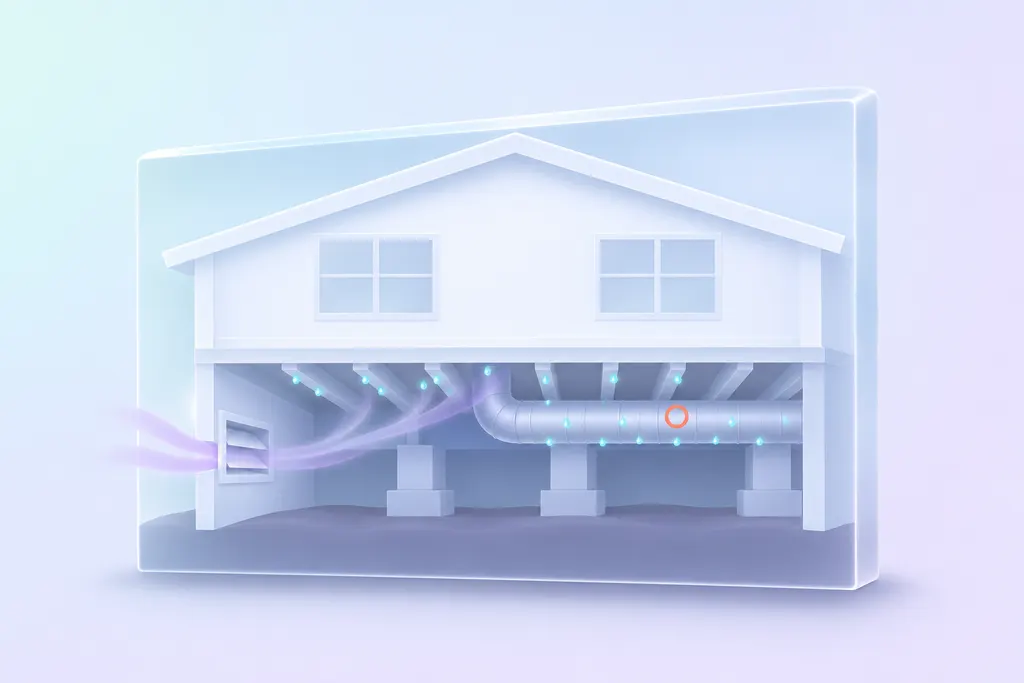
When it is likely worth it
- You live somewhere hot and humid and summer brings musty smells, damp insulation, or sweating ducts under the floor.
- Humidity stays high. EPA advises keeping indoor relative humidity below 60%, ideally 30–50%. A crawl space that sits well above that through the warm months is a candidate. Enter a reading below to see where it falls.
- Ducts, a furnace or a heat pump air handler sit in the crawl space. Sealing brings them inside the conditioned envelope instead of leaving them in damp outdoor air.
- You have pests or wood damage linked to moisture, once the water source is fixed.
Check a humidity reading
Enter what your humidity meter shows to see where it sits against EPA's range.
Bands from U.S. EPA — A Brief Guide to Mold, Moisture and Your Home: under 60% overall, 30–50% ideal.
When a liner or a drainage fix is enough
Building scientist Allison Bailes of Energy Vanguard argues that encapsulation suits many vented crawl spaces but not every house. In a dry climate a vented crawl space can perform fine, and a plain ground liner — 6-mil polyethylene or heavier, with lapped seams — cuts the moisture rising from the soil. If your readings are moderate and the space smells fine, the liner may be all you need; see our vapor barrier cost guide for that option.
If there is standing water, encapsulation is the wrong first step. Bailes is blunt that water problems must be fixed before sealing, and the DOE’s contractor checklist starts the same way: inspect for water, confirm drainage, and add perimeter drainage where the crawl floor sits below the outside grade. Gutters, downspout extensions and soil sloped away from the house are often the least costly part of the fix. Our page on standing water in a crawl space walks through those sources.
Three ways to handle a crawl space
Switch between the options. Fixing standing water comes before any of them.
- What it is
- Vents stay open; plastic sheeting covers the soil to cut moisture rising from the ground.
- Where it tends to work
- Dry climates and crawl spaces that stay dry year-round.
- What it does not handle
- Humid summer air coming in through the vents and condensing on cool ducts and joists.
- Upkeep
- Keep the liner intact and check for water after storms.
- Published price
- Liner material about $0.50–$0.70 per sq ft (one guide), plus labor.
- What it is
- Vents sealed, heavy liner on the ground and up the walls with taped seams, often wall insulation and a dehumidifier or conditioned air.
- Where it tends to work
- Humid climates, musty crawl spaces, ducts or equipment in the crawl space.
- What it does not handle
- Water flowing in from outside; that needs drainage or grading first.
- Upkeep
- Run and service the dehumidifier or air supply, watch humidity, test for radon.
- Published price
- $1,500–$15,000 per job; $3–$7 per sq ft for basic work (This Old House).
- What it is
- Gutters, downspout extensions, grading, and where needed an interior drain or sump.
- Where it tends to work
- Any crawl space with puddles, wet soil or water marks on the walls.
- What it does not handle
- Humid air and condensation once the ground is dry.
- Upkeep
- Clean gutters; keep downspout extensions in place.
- Published price
- Crawl space drainage $600–$1,800 (one guide); outside fixes often cost less.
Summarized from This Old House, HomeGrail, Energy Vanguard and the DOE Building America Solution Center. General information.
When to hold off
Bailes names two situations where sealing can cause harm, and the DOE checklist adds a third:
- Flood zones that require flood vents. Those vents exist to let floodwater pass through; a sealed crawl space that floods holds the water like a tub.
- Gas or oil appliances that draw combustion air from the crawl space. Sealing can starve them of air. The DOE checklist calls for a combustion safety test whenever natural-draft equipment is present.
- Radon. The DOE checklist calls for giving the owner a radon test after the work, with mitigation if levels come back above EPA’s acceptable level.
If water is standing near a furnace, water heater, pump or any wiring in the crawl space, do not go in. Have the power shut off by the utility or a licensed electrician first. For mold beyond about 10 square feet, EPA points past do-it-yourself cleanup to its professional remediation guidance.
Costs to weigh
Published prices agree on the middle and disagree on the top. This Old House gives $1,500 to $15,000 per job, $3 to $7 per square foot for basic work, and up to $10 per square foot where moisture problems are extensive; HomeGrail gives $1,500 to over $10,000. Both put the average near $5,500. A sealed space also needs a way to stay dry: a dehumidifier runs $800 to $1,200 installed in HomeGrail’s guide and $800 to $2,000 with wiring in This Old House’s.
Full job or liner only: scale to your floor area
Each row is one guide's per-square-foot range. The liner row is material only; labor is extra.
- Encapsulation, basic job$3–$7 per sq ft One sourceThis Old House — How much does crawl space encapsulation cost? · updated Mar 2026 · read Nov 2026
- Polyethylene vapor barrier only (material)$0.50–$0.70 per sq ft One sourceHomeGrail — How much does it cost to encapsulate a crawl space? · updated Jan 2026 · read Nov 2026
Encapsulation and add-ons: published ranges
Select a column heading to sort. National ranges, not quotes.
| Unit | ||||
|---|---|---|---|---|
| Crawl space encapsulation, whole job | $1,500 | $15,000 | per project | This Old House — Crawl space encapsulation cost · updated Mar 2026 · read Nov 2026 |
| Crawl space encapsulation (large homes can run higher) | $1,500 | $10,000 | per project | HomeGrail — Crawl space encapsulation cost · updated Jan 2026 · read Nov 2026 |
| Crawl space dehumidifier with wiring | $800 | $2,000 | per unit | This Old House — Crawl space encapsulation cost · updated Mar 2026 · read Nov 2026 |
| Crawl space dehumidifier, installed | $800 | $1,200 | per unit | HomeGrail — Crawl space encapsulation cost · updated Jan 2026 · read Nov 2026 |
| Encapsulation, basic job One source | $3 | $7 | per sq ft | This Old House — How much does crawl space encapsulation cost? · updated Mar 2026 · read Nov 2026 |
| Polyethylene vapor barrier only (material) One source | $0.50 | $0.70 | per sq ft | HomeGrail — How much does it cost to encapsulate a crawl space? · updated Jan 2026 · read Nov 2026 |
| Crawl space dehumidifier, installed | $800 | $1,200 | per unit | HomeGrail — How much does it cost to encapsulate a crawl space? · updated Jan 2026 · read Nov 2026 |
| Crawl space drainage system One source | $600 | $1,800 | per project | This Old House — How much does crawl space encapsulation cost? · updated Mar 2026 · read Nov 2026 |
| Mold removal before sealing One source | $500 | $4,000 | per project | This Old House — How much does crawl space encapsulation cost? · updated Mar 2026 · read Nov 2026 |
| Sealing a foundation vent | $10 | $22 | each | This Old House — How much does crawl space encapsulation cost? · updated Mar 2026 · read Nov 2026 |
| Sealed vent | $15 | $22 | each | HomeGrail — How much does it cost to encapsulate a crawl space? · updated Jan 2026 · read Nov 2026 |
There is no reliable published figure for how much encapsulation adds to resale value, so weigh it on comfort, moisture and energy rather than on a sale price. For a line-by-line breakdown, see the crawl space encapsulation cost guide.
Questions before you sign
Before you sign an encapsulation contract
Answers you want in writing.
0 of 7 done
Questions people ask
Is encapsulation worth it in a dry climate?
Often not. Where outdoor air is dry, a vented crawl space with a sound ground liner usually stays dry enough. Encapsulation makes more sense if readings stay high or the space smells musty anyway.
Can I just close the vents and put down plastic?
Closing vents without sealing the ground, walls and air leaks, and without a way to dry the air, can leave the space damper than before. A sealed crawl space needs a drying method such as a dehumidifier or a small supply of conditioned air.
Will encapsulation lower my energy bill?
It can. DOE research found 15% to 18% lower heating and cooling energy in properly built sealed, conditioned crawl spaces. Results vary with climate, ducts and how well the job is done.
How do I know if my crawl space is too humid?
Put a hygrometer in the crawl space for a few weeks of warm weather. The leak path finder helps sort humid air from water coming in, and suggests the matching fixes.
Pictures on this page are schematic drawings made with an AI image tool. They are not photos of any real basement, house, product, repair job or person.
Sources 7
- U.S. Department of Energy Unvented, conditioned crawlspaces: Building America Top Innovation Jan 7, 2014 (opens in a new tab)
- DOE Building America Solution Center Vented to unvented crawl space checklist read Nov 24, 2026 (opens in a new tab)
- This Old House Should crawl space vents stay open or closed? updated Apr 15, 2026 (opens in a new tab)
- This Old House How much does crawl space encapsulation cost? updated Mar 13, 2026 (opens in a new tab)
- HomeGrail How much does it cost to encapsulate a crawl space? updated Jan 9, 2026 (opens in a new tab)
- Energy Vanguard Should you encapsulate your crawl space? Allison Bailes, Oct 18, 2022 (opens in a new tab)
- U.S. EPA A brief guide to mold, moisture and your home read Nov 24, 2026 (opens in a new tab)
Figures were read on the dates shown. Prices are national ranges from cost guides, not quotes for your home.