A professionally installed crawl space vapor barrier usually costs about $1,500 to $4,000. Fixr gives that range for a 1,500-square-foot crawl space, and ThePricer, an aggregator citing HomeGuide’s 2026 figures, gives $2 to $4 per square foot installed, or about $2,000 to $4,000 for 1,000 square feet. The plastic itself is a small part of the bill: one retailer’s rolls run from under $0.07 per square foot for thin 6-mil sheet to just under $0.47 for a 20-mil liner, and HomeGrail’s general material figure is $0.50 to $0.70. What moves the price most is labor, liner thickness, and whether the sheet stops at the floor or runs up the walls. A full encapsulation, which adds sealed vents and a drying method, costs several times more.
Installed cost by crawl space size
Only two readable sources give an installed price for a barrier on its own, and they line up fairly well. Use the slider to apply the per-square-foot rates to your floor area; the material rows show how little of the installed price is the plastic.
Vapor barrier: installed price vs. material only
The first row is installed (labor and material). The others are plastic only, before overlaps and waste.
- Vapor barrier, installed (aggregator citing HomeGuide 2026)$2–$4 per sq ft One sourceThePricer — How much does a crawl space vapor barrier cost? · updated Oct 2026 · read Nov 2026
- Plastic sheeting only, thinnest grade$0.05–$0.20 per sq ft One sourceThis Old House — Crawl space encapsulation cost · updated Mar 2026 · read Nov 2026
- Plastic sheeting only, heaviest grade$0.40–$0.60 per sq ft One sourceThis Old House — Crawl space encapsulation cost · updated Mar 2026 · read Nov 2026
- Polyethylene barrier, material$0.50–$0.70 per sq ft One sourceHomeGrail — Crawl space encapsulation cost · updated Jan 2026 · read Nov 2026
The material rows also disagree with each other. This Old House prices plastic sheeting from $0.05 to $0.20 per square foot for its thinnest grade up to $0.40 to $0.60 for its heaviest (the page labels thickness in millimeters, which must be a slip for mil, the unit U.S. liners are sold in: 1 mil is a thousandth of an inch, about 0.025 mm, so a 20-millimeter sheet would be roughly 3/4 inch thick). HomeGrail gives $0.50 to $0.70 for a polyethylene barrier. Both guides list seam tape separately: This Old House at $18 to $50 a roll, HomeGrail at about $50.
Thickness: what you pay for
Crawl space liners are sold by thickness in mils (thousandths of an inch). Retail roll prices from one supplier, Crawlspace Depot, read on its catalog page on November 24, 2026, show how cost climbs with thickness:
Liner material by thickness: one retailer's roll prices
Select a column heading to sort. National ranges, not quotes.
| Unit | ||||
|---|---|---|---|---|
| 6-mil plain polyethylene (10×100 ft roll, $65.99) One source | $0.07 | $0.07 | per sq ft | Crawlspace Depot — Vapor barriers catalog · updated Nov 2026 · read Nov 2026 |
| 10-mil woven-coated liner (12×100 ft roll, $272.99) One source | $0.23 | $0.23 | per sq ft | Crawlspace Depot — Vapor barriers catalog · updated Nov 2026 · read Nov 2026 |
| 12-mil economy liner (12×100 ft roll, $334.99) One source | $0.28 | $0.28 | per sq ft | Crawlspace Depot — Vapor barriers catalog · updated Nov 2026 · read Nov 2026 |
| 20-mil reinforced liner (12×100 ft roll, $559.99) One source | $0.47 | $0.47 | per sq ft | Crawlspace Depot — Vapor barriers catalog · updated Nov 2026 · read Nov 2026 |
| 6-mil reinforced polyethylene (about $150 per 10×100 ft roll) One source | $0.15 | $0.15 | per sq ft | Green Building Advisor — The most common vapor retarder for crawlspaces · updated Aug 2024 · read Nov 2026 |
What thickness do you need? Building America’s guides call for polyethylene of at least 6 mil. Green Building Advisor notes that the residential code section for sealed crawl spaces asks for a Class I vapor retarder without naming a thickness. Its practical advice: 6-mil may be fine in a crawl space nobody enters, while 10-mil or heavier holds up better where people crawl to service ducts and pipes or store things. Reinforced sheet resists tearing but can still be punctured. Thicker sheet is a durability upgrade, not a different kind of moisture control.
Ground only or ground and walls?
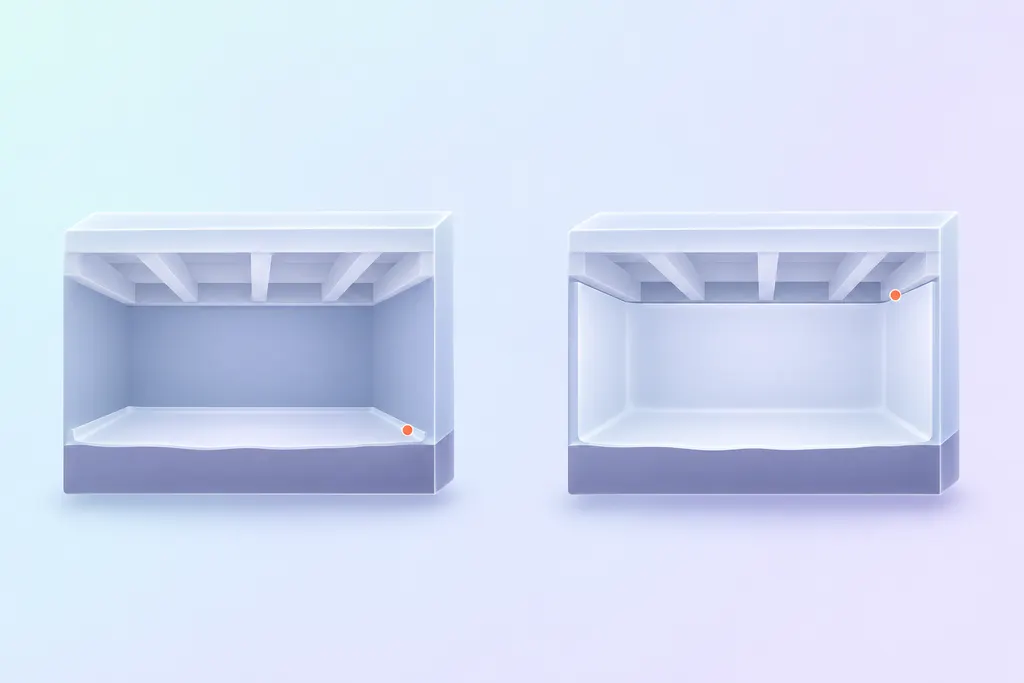
The basic job covers the dirt floor. Building America’s guide for vented and unvented crawl spaces says to lap the sheet at least 6 inches up the walls and piers, overlap seams 6 to 12 inches, and seal them with tape or sealant made for polyethylene. Its guide for existing crawl spaces goes further, suggesting 8 to 12 inches up the walls, or preferably up to the outside ground level.
Covering the walls fully is part of sealing a crawl space. For unvented crawl spaces, Building America carries the liner to within about 4 inches of the top of the wall, leaving a bare strip in termite areas so the wall can be inspected. More coverage means more material, more fastening and more sealing time.
Ground cover, ground and walls, or full encapsulation
Switch between the options to compare them point by point.
- What it covers
- The dirt floor, lapped at least 6 inches up walls and piers.
- What it does
- Slows moisture evaporating from the soil into the crawl space.
- Vents
- Stay open; the space is still vented.
- Published cost
- About $2–$4 per sq ft installed (one aggregator); $1,500–$4,000 for 1,500 sq ft (Fixr).
- Fits when
- The space is dry, with no pooling water, and you want basic moisture control.
- What it covers
- Floor plus foundation walls, up to near the top or to outside ground level.
- What it does
- Also blocks moisture coming through the walls; a step toward a sealed space.
- Vents
- May stay open or be sealed later.
- Published cost
- More than ground only; more sheet, fastening and sealing. No guide we read prices it separately.
- Fits when
- Walls are damp or you plan to seal the space in stages.
- What it covers
- Floor, walls, piers, sealed vents and access door.
- What it does
- Turns the crawl space into a sealed, dried space.
- Vents
- Closed and sealed; a dehumidifier, exhaust fan or conditioned air dries it.
- Published cost
- $1,500–$15,000 (This Old House).
- Fits when
- Humid climate, musty smell, ducts or equipment in the crawl space.
Vapor barrier vs. encapsulation
A vapor barrier is one part of encapsulation. On its own, it slows the moisture that evaporates from damp soil into the crawl space, but the space stays vented to outside air. Encapsulation adds sealed vents, a sealed access door, full wall coverage and a way to dry the air, usually a dehumidifier. This Old House puts encapsulation at $1,500 to $15,000; see the crawl space encapsulation cost guide for the breakdown, and is crawl space encapsulation worth it for when the bigger job pays off.
A liner does not fix liquid water. If water pools on the floor after rain, plastic laid over it traps the problem. Building America’s guidance for existing crawl spaces puts drainage first. Start with standing water in a crawl space.
What changes the price
- Floor area and wall height. Most of the cost scales with square footage of sheet laid and sealed.
- Access. Low clearance, ductwork and many piers slow the work.
- Prep. Removing old plastic, debris or fallen insulation adds labor.
- Thickness and reinforcement. A 20-mil roll costs several times a 6-mil one and is stiffer to work in a low space.
- Fastening and sealing. Mechanically fastened, fully taped edges take longer than a loose sheet weighed down at the edges.
If you find standing water, wet wiring, a sagging floor, or mold larger than about 10 square feet, stop and bring in the right professional before any liner goes down: a licensed electrician for wiring, a licensed structural engineer for sagging framing, and a mold remediation company for large growth.
Before the liner goes down
Before the liner goes down
Whether you hire it out or not. Ticks stay in this browser only.
0 of 7 done
The leak path finder can help you check whether damp air, ground moisture or water is the real issue before you buy plastic.
Questions people ask
What thickness vapor barrier is used in a crawl space?
Building science guidance treats 6 mil as the minimum. Heavier 10-, 12- and 20-mil liners are widely sold for crawl spaces because they resist tearing, which matters if people crawl over them.
Can I install a crawl space vapor barrier myself?
Laying and taping sheet is a common owner project, and material is the small part of the cost. Do not do it in a crawl space with standing water, damaged wiring or large mold growth; those need a professional first.
Should the vapor barrier go up the walls?
At least partway. Building America’s guides call for a minimum of 6 inches up walls and piers, and more where you want the space sealed.
How long does a crawl space vapor barrier last?
It depends on thickness, traffic and pests. Thin sheet tears easily when people crawl over it; heavier and reinforced liners hold up longer. Inspect it after any service visit and patch tears with tape made for polyethylene.
Not sure a liner is enough?
Open the finder with a damp crawl space marked, then add when it happens and any clues to see which fixes fit.
Pictures on this page are schematic drawings made with an AI image tool. They are not photos of any real basement, house, product, repair job or person.
Sources 9
- Fixr Crawl space repair cost updated Jan 31, 2025 (opens in a new tab)
- ThePricer How much does a crawl space vapor barrier cost? updated Oct 30, 2026aggregator citing HomeGuide 2026 (opens in a new tab)
- Crawlspace Depot Vapor barriers catalog retail roll pricesread Nov 24, 2026 (opens in a new tab)
- This Old House Crawl space encapsulation cost updated Mar 13, 2026 (opens in a new tab)
- HomeGrail How much does it cost to encapsulate a crawl space? updated Jan 9, 2026 (opens in a new tab)
- Green Building Advisor (Randy Williams) The most common vapor retarder for crawlspaces Aug 15, 2024 (opens in a new tab)
- U.S. DOE Building America Solution Center Capillary Break: Crawlspace Floors, Polyethylene Lapped Up Walls and Piers read Nov 24, 2026 (opens in a new tab)
- U.S. DOE Building America Solution Center Water Management of Existing Crawlspace Floor updated Feb 9, 2015 (opens in a new tab)
- U.S. DOE Building America Solution Center Unvented, Insulated Crawlspaces updated Sep 23, 2021 (opens in a new tab)
Figures were read on the dates shown. Prices are national ranges from cost guides, not quotes for your home.