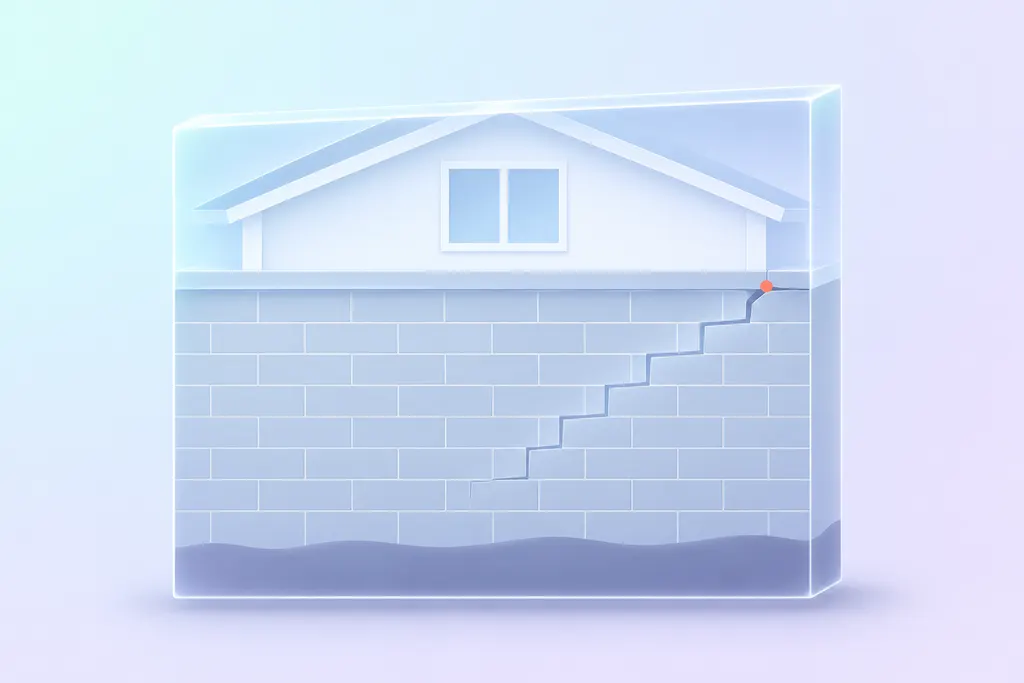
A stair-step crack in a concrete block wall follows the mortar joints up and across, and it usually means part of the wall has moved: either a section of footing has settled, or soil outside has pushed the wall inward (thin ones can also come from shrinkage and temperature swings alone). Many such cracks are old and stable, but you cannot tell which kind you have by looking once. If the crack is wider than about 1/8 inch, has an offset, sits beside a bulge or a horizontal crack, or keeps changing, have a licensed structural engineer look at it. What follows is general information, not an engineering opinion.
Why block walls crack in steps
A block wall is a stack of strong units joined by weaker mortar. When the wall is strained, it breaks along the weakest path, which is the mortar between the blocks. Because each course is offset by half a block, the break climbs in a staircase rather than a straight line.
That staircase is a record of strain, not of a single cause. InspectAPedia, a building inspection reference, lists several triggers for diagonal and step cracking:
- Settlement — fill under the footing that was never compacted well, a house built on a slope, soil washed away by roof runoff, or a footing that bears on a boulder at one point and soft soil at another.
- Frost and wet soil — frost pushing on the wall, or saturated soil pressing on it, often at corners in cold climates.
- Restraint — walls are held at the footing and the corners, so movement concentrates between those fixed points.
- Shrinkage and temperature — masonry and concrete change size with moisture and heat, which can crack a wall with no settlement at all.
Settling or soil pushing in?
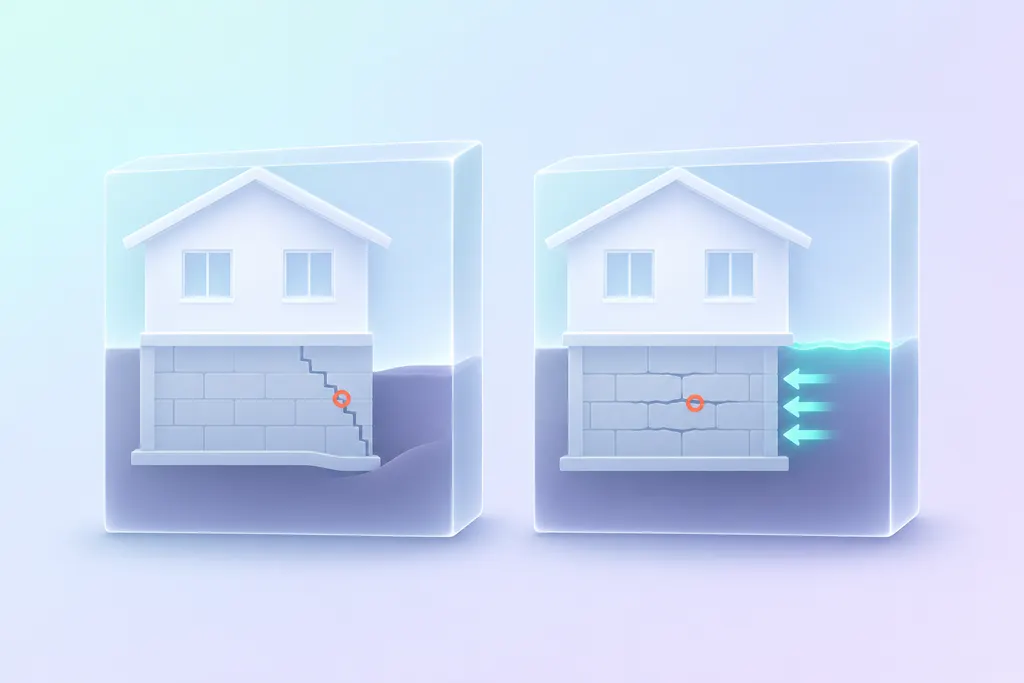
The two main causes leave different fingerprints, and they call for different repairs. The comparison below sets them side by side.
Settling or soil pushing in? The usual patterns
Switch between the two causes. Real walls can show both; an engineer decides which is at work.
- Where it usually starts
- At or near a corner, or from a corner toward a window or door opening.
- Shape of the crack
- Steps up and away from the low spot; often wider at one end, at the top or the bottom.
- What else you may see
- Blocks on one side sitting lower than the other, sloping floors, sticking doors upstairs.
- Usual causes
- Poorly compacted fill, roof water soaking the soil at one corner, soil washing away, a footing on uneven support.
- Typical repair family
- Fix the drainage; if the footing is still sinking, piers or other underpinning chosen by the engineer.
- Where it usually starts
- Toward the middle of a long wall, often branching off a horizontal crack.
- Shape of the crack
- Stair-steps that run down toward the corners from a sideways crack in the middle.
- What else you may see
- An inward bulge when you sight along the wall, blocks pushed in past the ones below.
- Usual causes
- Wet, heavy or expansive soil against the wall, frost in cold climates, water pooling along that side.
- Typical repair family
- Fix the drainage; reinforce the wall with straps, anchors, tiebacks or beams as the engineer specifies.
Patterns summarized from InspectAPedia's guide to diagonal and step cracks in block walls. General information, not an engineering opinion.
InspectAPedia adds two details that help. A step crack that is wider at the bottom than the top suggests settlement under that part of the building. One that is wider at the top, running from a corner toward a window or door, can come from settlement, expansive clay, frost, or roots pushing on the wall. And stepped cracks that appear together with a horizontal crack toward the middle of the wall point to earth pressure from outside — the pattern described in our page on horizontal cracks in a foundation wall.
Old and stable or still moving?
Plenty of houses carry a step crack that formed in the first few years and never changed. What separates those from active ones is behavior over time, which is why a season of observation is worth more than any single photo.
InspectAPedia treats hairline cracks under 1/16 inch as posing little immediate risk on their own, though the cause should still be fixed. It reads cracks over 1/8 inch, especially ones that have reopened after an earlier repair, as signs of ongoing or seasonal movement. Other warning signs it lists:
- a patch or caulk line that has cracked again;
- the crack looks wider once loose paint or parging is scraped back;
- the crack continues down into the footing;
- it opens and closes with the seasons, or leaks more each year.
Displacement matters too. If the blocks on one side of the crack sit lower or further in than the blocks beside them, the wall has shifted, not just cracked. A wall that bulges inward needs prompt attention; InspectAPedia’s guide to horizontal cracks reports that engineers regard an inward bow of 1 inch or more in a block wall as serious.
Track a stair-step crack over a season
Observation only. Leave the wall, the soil next to it and any loose blocks alone.
0 of 6 done
Do not chisel out mortar, remove loose blocks, or dig along the outside of a cracked block wall to “check the footing.” Disturbing a strained wall or the soil holding it can make it move. Leave investigation that involves opening the wall or the ground to the engineer.
Why not just fill the crack?
Filling a stair-step crack is tempting because it looks tidy afterward. InspectAPedia cautions that these cracks should not simply be caulked or epoxied, because the cause has to be found first. Its order of work: find the cause, judge whether the wall is stable and support it if needed, correct the cause (roof runoff, downspouts, grading, drainage, footing problems), and only then repair or rebuild the wall.
For a thin crack that an engineer has judged stable and that only lets in water, sealing is a normal fix. Price ranges for crack repair run from $200 to $1,000 per crack in Fixr’s guide and $250 to $800 in This Old House’s.
What the next steps cost
The engineer’s visit is the first spend: Fixr’s structural engineer guide gives $300–$600 for a foundation inspection, while This Old House gives $500–$1,000. If the engineer finds a settling corner, piers are a common repair; both Fixr and This Old House put a single pier at $1,000 to $3,000, and a job usually needs several. A wall pushed in by soil is reinforced instead — Fixr’s single range for bowing wall repair is $4,000 to $15,000.
Stair-step cracks: published ranges for each next step
Select a column heading to sort. National ranges, not quotes.
| Unit | ||||
|---|---|---|---|---|
| Foundation crack repair (sealing or injection) | $200 | $1,000 | per crack | Fixr — Foundation repair cost · updated Jan 2026 · read Nov 2026 |
| Crack filling (epoxy, polyurethane or hydraulic cement) | $250 | $800 | per crack | This Old House — How much does foundation repair cost? · updated Oct 2026 · read Nov 2026 |
| Foundation inspection by a structural engineer | $300 | $600 | per visit | Fixr — Structural engineer cost · updated Jan 2025 · read Nov 2026 |
| Structural engineer inspection | $500 | $1,000 | per visit | This Old House — How much does foundation repair cost? · updated Oct 2026 · read Nov 2026 |
| Foundation pier (settling corner or wall) | $1,000 | $3,000 | per pier | Fixr — Foundation repair cost · updated Jan 2026 · read Nov 2026 |
| Piering or underpinning | $1,000 | $3,000 | per pier | This Old House — How much does foundation repair cost? · updated Oct 2026 · read Nov 2026 |
| Bowing wall repair, whole job One source | $4,000 | $15,000 | per project | Fixr — Foundation repair cost · updated Jan 2026 · read Nov 2026 |
Our comparison of piers, anchors and carbon fiber explains what each repair does, and the foundation repair cost guide covers what moves the total.
Questions to ask the engineer
- Is this crack from settlement, soil pressure, frost or shrinkage — and is it still active?
- Is any part of the wall displaced or bowing, and by how much?
- Does the outside drainage at this corner or wall need fixing first?
- Do you recommend monitoring, sealing, reinforcement or underpinning, and why?
- Can the report state the scope so that I can get comparable quotes?
Questions people ask
Are stair-step cracks in a basement wall normal?
They are common in block foundations, and many are old and stable. Common does not mean harmless, though: the crack shows the wall moved at some point. Whether it is still moving is the real question.
How wide is too wide for a stair-step crack?
There is no single cut-off. One inspection reference reads anything over 1/8 inch, especially with a failed earlier repair, as a sign of ongoing movement. An offset or a bulge matters more than width alone.
Can a stair-step crack be repaired without piers?
Yes, when the cause is fixed and the wall has stopped moving. Many are handled by correcting the drainage and having a contractor repoint or seal the joints. Piers come in only when the engineer finds the footing is still sinking.
Do stair-step cracks let water in?
They can, because the mortar joints open a path through the wall. The leak path finder sorts out whether water at a crack comes from runoff, groundwater or condensation.
Water showing up along the crack?
Open the finder with a wall crack marked and rain as the trigger, then add your other clues.
Pictures on this page are schematic drawings made with an AI image tool. They are not photos of any real basement, house, product, repair job or person.
Sources 5
- InspectAPedia Diagonal or step cracks in concrete block walls and foundations read Nov 24, 2026 (opens in a new tab)
- InspectAPedia Horizontal foundation cracks read Nov 24, 2026 (opens in a new tab)
- Fixr How much does foundation repair cost? updated Jan 27, 2026 (opens in a new tab)
- This Old House How much does foundation repair cost? updated Oct 8, 2026 (opens in a new tab)
- Fixr Structural engineer cost updated Jan 31, 2025 (opens in a new tab)
Figures were read on the dates shown. Prices are national ranges from cost guides, not quotes for your home.