A horizontal crack in a basement or foundation wall usually means something outside is pushing on the wall hard enough to bend it — most often wet, heavy soil, sometimes frost or the weight of vehicles near the house. Unlike the thin vertical lines that concrete leaves as it dries, a sideways crack is a sign of load, so treat it as a question for a licensed structural engineer, whatever its width. This page is general information, not an engineering opinion; it explains what the crack can mean so you can describe it well and ask the right questions.
If the wall visibly bulges, leans, or has shifted along the crack, keep people and heavy items away from that side of the basement and call a structural engineer promptly. Do not dig beside the wall, remove soil, or brace it yourself.
Why a sideways crack gets more attention
Soil presses on a buried wall all the time. When it gets soaked, it weighs more and pushes harder; in cold climates, freezing water in the soil can push as well. A basement wall is held at the bottom by the footing and floor slab and at the top by the house framing, so the middle has the most room to bend. When it bends, the inside face stretches, and concrete or mortar breaks in a line along the wall.
Vertical shrinkage cracks, by contrast, form whether or not anything pushes on the wall. That is why inspection guides and repair contractors alike sort horizontal cracks into a different, more serious group.
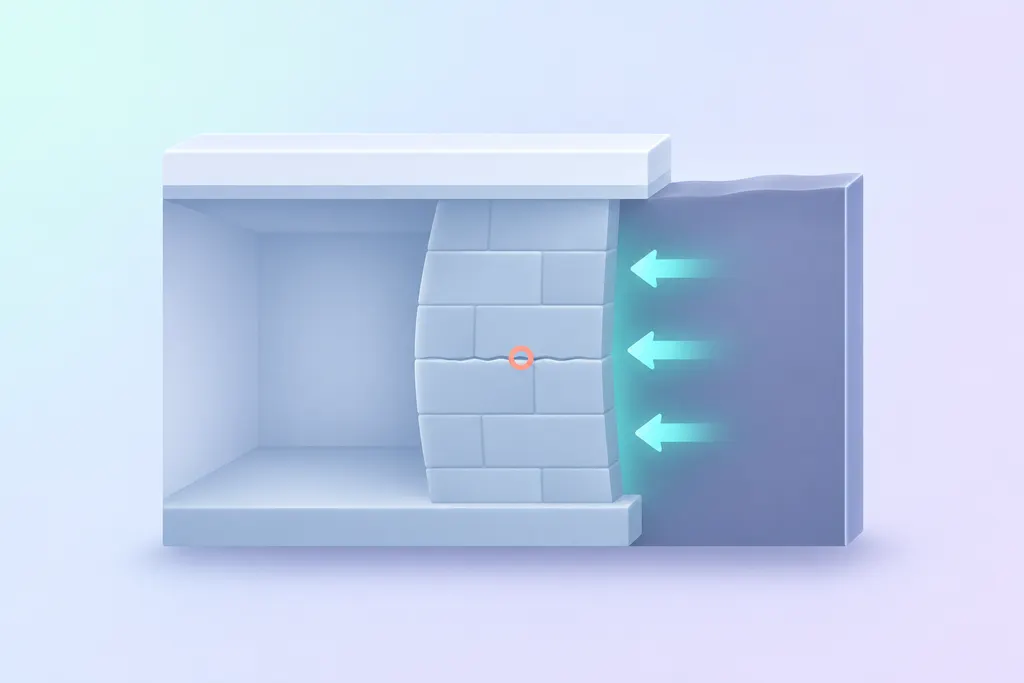
Where the crack sits is a clue
InspectAPedia, an inspection reference, links the height of a horizontal crack to its likely cause:
- Upper third of the wall: often frost pushing on the top of the wall, or loads from cars and trucks parked or driven close to the house. Damage only on walls under the eaves, where roof water drips, points toward frost.
- Middle third: most often soil pressure, made worse by wet ground, especially when backfill reaches near the top of the wall and the crack sits below frost depth.
- Near the floor: soil pressure is greatest at the bottom of the wall, and a wall pushed in at its base points to earth loading. In block walls this break often follows the first mortar joint above the slab.
The same source notes that early or heavy backfilling during construction, and houses built into a hillside, raise the risk. Attached garages, whose footings are often shallower than the house’s, are prone to frost and settlement cracks of their own. These are clues, not a diagnosis — the engineer weighs them against what the rest of the house shows.
Block walls versus poured concrete
Both kinds of wall can crack sideways from the same causes. In a concrete block wall the crack usually runs along a mortar joint, and it often turns into a stair-step pattern near the corners, where the side walls hold the wall in place. A poured wall tends to show a single long crack. InspectAPedia warns that unreinforced block, brick or stone walls that are badly buckled can collapse suddenly, which is why a bowing block wall deserves a prompt visit rather than a wait-and-see season. If you also see stepped cracks, our page on stair-step cracks in block foundations explains how they relate.
Signs that the wall is moving
A crack alone is a record of something that happened. Movement is what turns it into a repair job. The signs worth noting:
- the crack is wider in the middle of the wall than at the ends;
- the wall curves inward when you sight along it from a corner;
- the top of the wall has slid in past the bottom (a step at the crack);
- the crack gets longer or wider between checks, or seeps after heavy rain;
- doors or windows upstairs start to stick.
InspectAPedia reports that engineers treat an inward bulge or lean of 1 inch or more in a block or brick wall as serious. One cost guide, Today’s Homeowner, describes bowing under about 2 inches as the range where wall anchors are typically used, and calls more than 4 inches a major problem. These thresholds come from single sources and are a guide for your conversation with the engineer, not a rule to apply yourself.
What to do before anyone quotes a repair
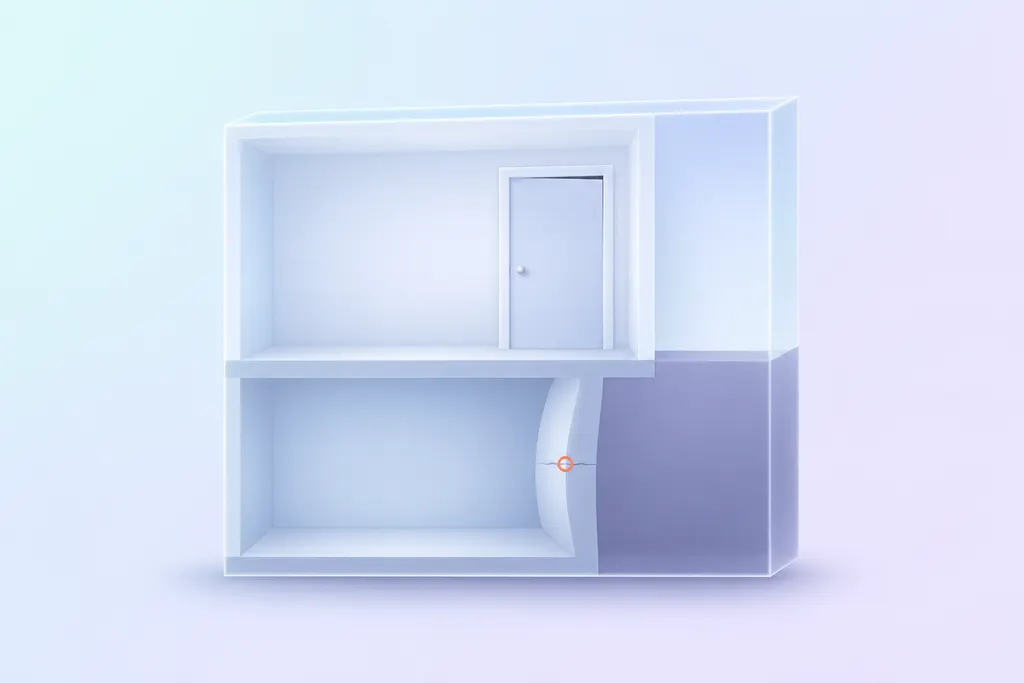
The useful steps are all observation: measure, mark, and photograph, then have the wall assessed. Keep water away from the wall in the meantime — clean gutters and make sure downspouts discharge well away from the house — because soaked soil adds pressure. Avoid sealing the crack before the engineer sees it; a sealed crack hides whether it is still opening.
Before the engineer arrives: what to record
Look and measure only. Do not dig, chip or brace anything yourself.
0 of 7 done
An engineer is paid for the assessment, not the repair, and the written report gives every contractor the same scope to price. Some repair companies offer an inspection at no charge, but a salesperson’s visit is not an engineer’s opinion.
What repairs and an assessment cost
The engineer’s visit is the first cost. Published ranges disagree: Fixr’s structural engineer guide gives $300–$600 for a foundation inspection, This Old House gives $500–$1,000, and Fixr’s foundation repair guide stretches a full report to $2,000. If the wall needs reinforcement, the common options are carbon fiber straps, wall anchors, helical tiebacks, steel beams, and in severe cases excavation and rebuilding. Fixr and This Old House both put carbon fiber or steel strips at $4,000–$12,000 (This Old House prices a set of 12 strips); Fixr gives $4,000–$15,000 for bowing wall repair in general.
Engineer and wall reinforcement: published ranges
Select a column heading to sort. National ranges, not quotes.
| Unit | ||||
|---|---|---|---|---|
| Foundation inspection by a structural engineer | $300 | $600 | per visit | Fixr — Structural engineer cost · updated Jan 2025 · read Nov 2026 |
| Structural engineer inspection | $500 | $1,000 | per visit | This Old House — How much does foundation repair cost? · updated Oct 2026 · read Nov 2026 |
| Structural engineer's report | $300 | $2,000 | per report | Fixr — Foundation repair cost · updated Jan 2026 · read Nov 2026 |
| Carbon fiber reinforcement strips | $4,000 | $12,000 | per project | Fixr — Foundation repair cost · updated Jan 2026 · read Nov 2026 |
| Steel or carbon fiber strips (set of 12) | $4,000 | $12,000 | per project | This Old House — How much does foundation repair cost? · updated Oct 2026 · read Nov 2026 |
| Bowing wall repair, whole job One source | $4,000 | $15,000 | per project | Fixr — Foundation repair cost · updated Jan 2026 · read Nov 2026 |
Per-foot prices let you scale the figure to your wall. They come from one guide only, and they assume anchors or tiebacks every 5 feet and straps about every 4 feet.
Scale the reinforcement price to your wall
Move the slider to the length of the affected wall. Each row multiplies one per-foot range from Today's Homeowner.
- Carbon fiber or steel straps$85–$275 per linear foot One sourceToday's Homeowner — Bowing basement wall repair costs · updated May 2025 · read Nov 2026
- Wall anchors$80–$150 per linear foot One sourceToday's Homeowner — Bowing basement wall repair costs · updated May 2025 · read Nov 2026
- Helical tiebacks$300–$360 per linear foot One sourceToday's Homeowner — Bowing basement wall repair costs · updated May 2025 · read Nov 2026
Which method fits depends on how far the wall has moved, the soil, and room to work outside; our comparison of piers, anchors and carbon fiber walks through the trade-offs, and the foundation repair cost guide covers the wider price picture.
Questions people ask
Is a horizontal crack in a basement wall always serious?
Not always, but it is never one to dismiss. A short, thin crack high on a wall that has not moved for years may be old frost or construction damage. Only an on-site assessment can tell an old, stable crack from an active one, which is why the usual advice is an engineer first.
Can I just seal a horizontal crack to stop the leak?
Sealing stops water, not movement. If the wall is still bending, the crack reopens and the wall keeps moving behind the patch. Let the engineer decide whether the wall needs reinforcement before you seal anything.
How fast does a bowing wall get worse?
It depends on soil, water and season. Some walls barely change for years; others move after a single wet spring or a hard freeze. Dated marks at each end of the crack, checked after heavy rain, show you which kind you have.
Does a horizontal crack mean my house will fail inspection when I sell?
A buyer’s inspector will almost certainly flag it and recommend a structural evaluation. Having an engineer’s report and, if needed, documented repairs in hand usually makes that conversation easier.
Is water coming in along the crack?
Open the leak path finder with a sideways crack marked, then add when it leaks to see the usual water fixes beside the structural ones.
Pictures on this page are schematic drawings made with an AI image tool. They are not photos of any real basement, house, product, repair job or person.
Sources 5
- InspectAPedia Horizontal foundation cracks read Nov 24, 2026 (opens in a new tab)
- Today's Homeowner Bowing basement wall repair costs updated May 28, 2025 (opens in a new tab)
- Fixr How much does foundation repair cost? updated Jan 27, 2026 (opens in a new tab)
- This Old House How much does foundation repair cost? updated Oct 8, 2026 (opens in a new tab)
- Fixr Structural engineer cost updated Jan 31, 2025 (opens in a new tab)
Figures were read on the dates shown. Prices are national ranges from cost guides, not quotes for your home.